

the lowest tender is not always the lowest-cost Option
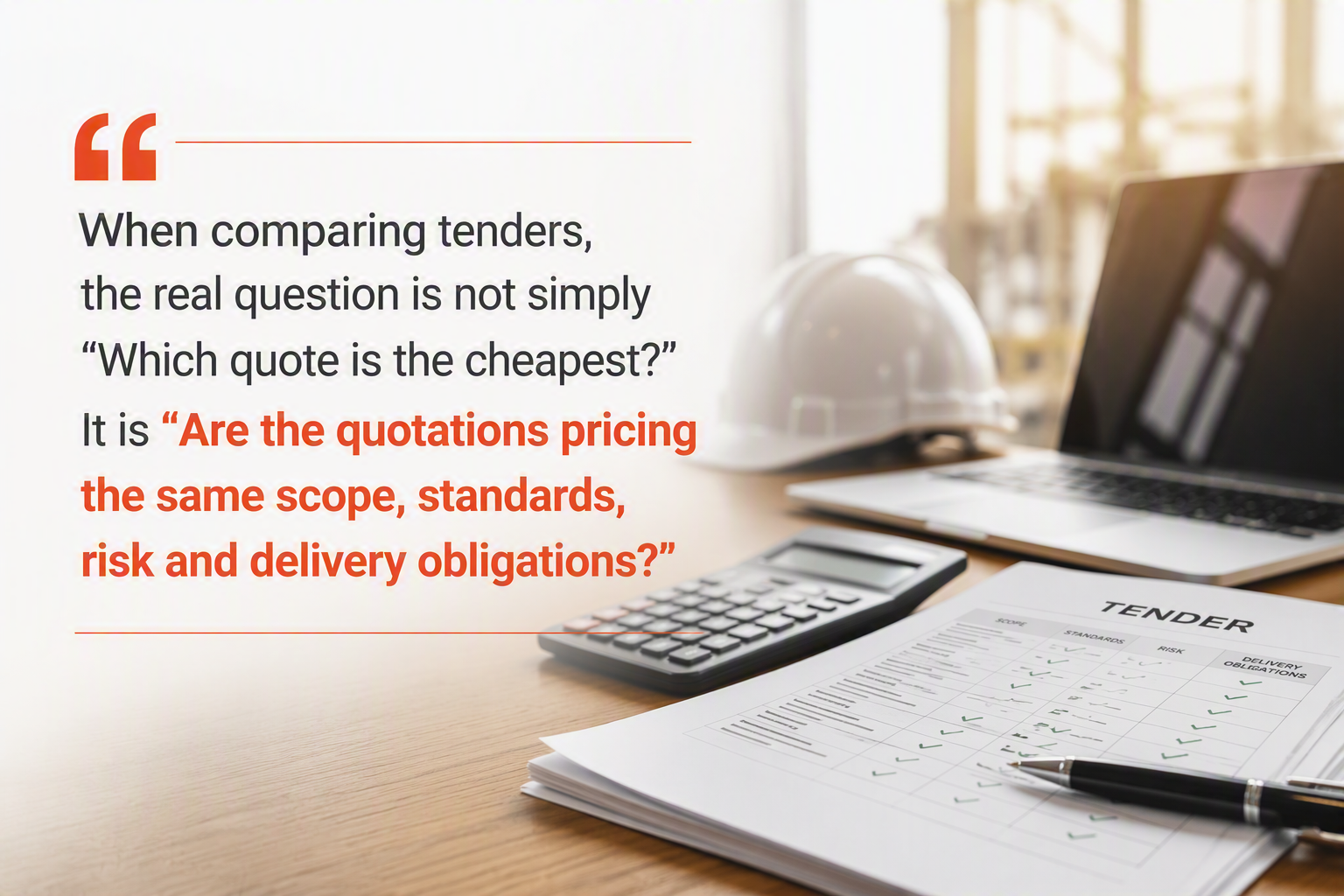
We receive feedback from time to time that Hampden’s pricing is higher than that of other contractors in our trade, sometimes significantly higher.
We understand that.
We recognise that every project has a budget and that price matters. However, two prices may appear to cover the same package while representing very different offers.
Not all tender prices are created equal
A head contractor we’ve worked for in the past recently sent an email reminding all its subcontractors to price what was genuinely required to complete the work properly, rather than leaving scope out to win the project and trying to recover the difference through variations. That approach strongly resonated with us.
Sharp pricing should come from sound planning, accurate quantities, efficient methodologies, informed procurement, realistic programming, early identification of risk and genuine value engineering. It should not depend on knowingly omitting necessary scope, compromising compliance, under-resourcing the work or assuming the project will absorb the shortfall later.
A low tender figure may reflect genuine efficiency. It may also mean something has been missed, assumed away, substituted or deferred. That is why the qualifications and clarifications within a pricing submittal matter just as much as the number at the bottom.
What sits behind Hampden’s pricing

Hampden has operated for more than 55 years. During that time, we have built the people, facilities, systems, technical knowledge and financial capacity needed to deliver specialist perimeter security work.
Our pricing supports an established, accountable New Zealand business, including:
• experienced in-house design, fabrication, project management and installation teams;
• working capital and procurement capability to support significant projects;
• trained people, competent supervision and robust health and safety systems;
• appropriate insurances, quality assurance, traceability and contractual accountability;
• fit-for-purpose materials, realistic freight, plant, mobilisation and programme allowances; and
• warranties, defects support, servicing and the capacity to return if an issue arises.
These costs do not always appear as separate line items. They are part of what enables us to deliver safely, competently and reliably, and to remain available well beyond practical completion.
When Low Pricing Becomes High Risk
When work is priced below the level required to deliver it, the shortfall has to land somewhere. It may place pressure on cash flow, suppliers and subcontractors. It may appear through aggressive variation claims, reduced supervision, product substitutions, insufficient resourcing or compromised programme performance.
In the worst case, the contractor may be unable to complete the work. In more severe circumstances, ongoing financial pressure can lead to insolvency or liquidation. In either case, for clients and head contractors, the consequences can be significant, including unfinished work, programme delays, warranty uncertainty, duplicated mobilisation and management costs, and the need to re-tender or appoint a replacement contractor.
That is why tender evaluation should consider not only price, but also whether the contractor has the proven capability, capacity and financial resilience required to deliver a project of the scale, complexity and delivery requirements involved.
Lowest Price + Best Value are not the same thing
Good procurement considers whole-of-life value, not just the initial construction price. New Zealand Government Procurement guidance takes a whole-of-life approach when estimating procurement value, including costs required for full delivery such as installation, maintenance, training, management and related services.
Although that guidance applies to government procurement, the underlying principle is equally useful for any client or head contractor comparing long-term value.
For perimeter security infrastructure, whole-of-life cost may include:
• design, procurement, installation and trade coordination;
• expected service life, preventative maintenance and replacement parts;
• repair frequency and operational disruption when equipment fails;
• testing, compliance, recertification and warranty protection; and
• removal, replacement and the consequences of the system not performing when required.
A cheaper gate that needs repeated call-outs, disrupts operations or requires early replacement is not necessarily the lower-cost gate. A fencing system that does not meet the required security or durability standard is not equivalent simply because it looks similar. Likewise, a crash-rated HVM product that is not installed in its tested configuration cannot be compared directly with a fully compliant, correctly installed system.
Removing Cost Is Not the Same as Creating Value
Don't get us wrong, we're not opposed to reducing cost. In fact, we're strong advocates for value engineering. Time and again, we see opportunities to reduce costs intelligently while maintaining compliance, performance, and the project's critical requirements. When we identify those opportunities, we'll put them forward every single time.
Experienced specialist contractors should actively look for better and more efficient ways to deliver. But there is a clear difference between value engineering and removing value.
Good value engineering can include refining the design before fabrication, selecting a more appropriate compliant system, coordinating foundations with civil works, resolving interfaces early, standardising components, consolidating deliveries or adjusting the fabrication and installation methodology.
True value engineering protects performance, compliance and operational intent.
Cost cutting that compromises those outcomes simply transfers cost and risk to a later stage.
The Assurance Behind Hampden’s Numbers
When a client engages Hampden, our price represents more than steel, concrete, fixings and labour. It represents:
Experience: more than 55 years in specialist perimeter security;
Capability: design, fabrication, procurement, project management, installation, service and maintenance;
Compliance and conformance: systems, products and methodologies aligned with the specification, relevant standards and required performance;
Capacity: the people, supplier relationships, plant and financial resources needed to support substantial projects; and
Accountability: a contractor that attends to defects, honours warranty commitments and remains involved after installation.
These are the fundamental requirements that sit behind the number on the page and give our clients confidence that the promised outcome can, and will, be delivered.
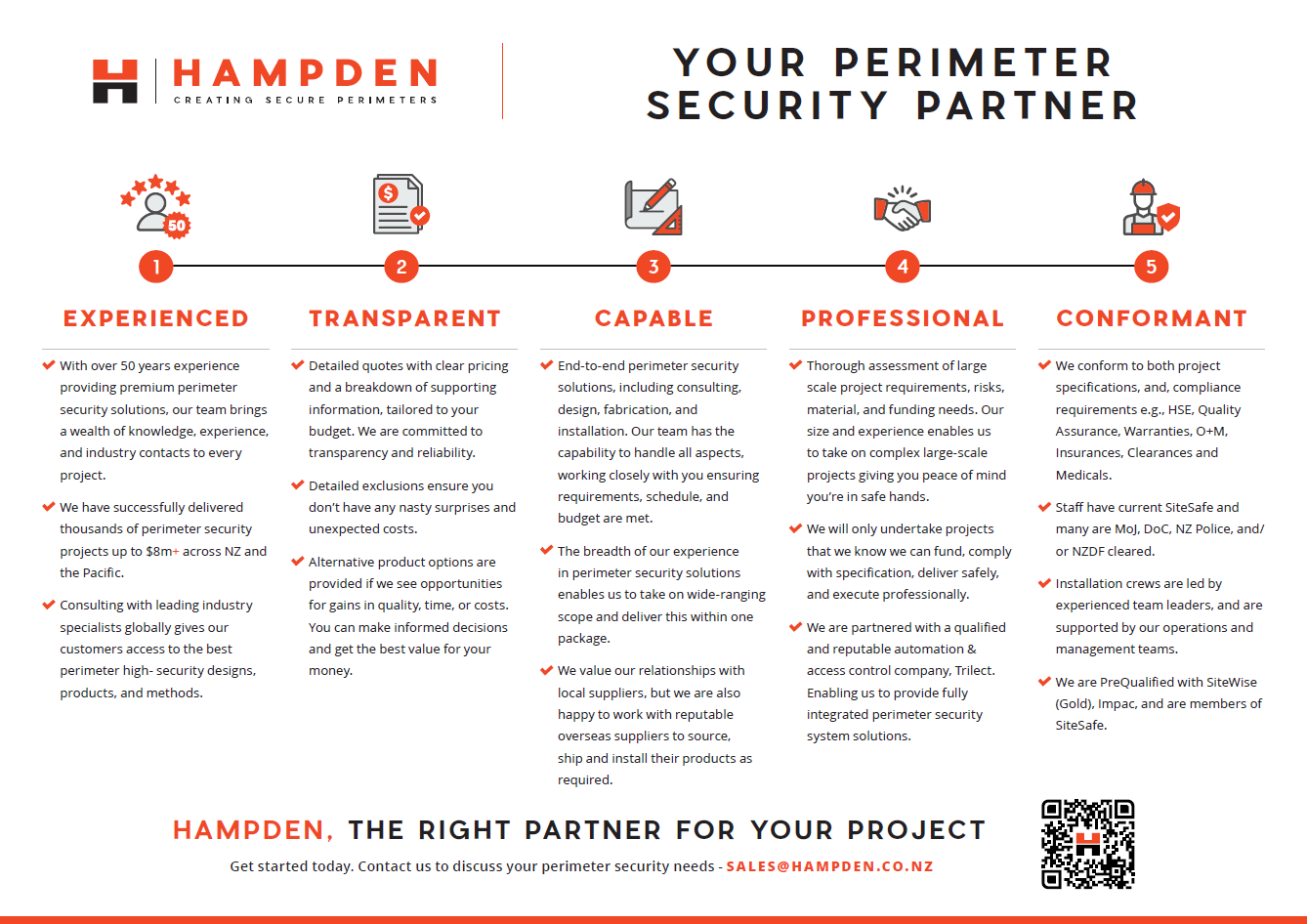
Hampden’s Capability
Learn more about Hampden's experience, capability, and commitment to delivering secure project outcomes. Download our Capability Statement today
Compare the outcome, not just the price
Construction needs competitive pricing, and responsible contractors should continually challenge themselves to deliver more efficiently. But competitiveness must also be complete and sustainable.
A clear and honest price may not be the lowest tender received. It does, however, give the project a realistic basis from which to proceed, reduces the likelihood of unpleasant surprises and provides greater confidence that the promised outcome can be delivered.
The best outcomes are often achieved long before tenders are submitted. If you're planning a perimeter security project, talk to Hampden early. Our experience across design, procurement, fabrication and installation can help identify risks, support value engineering, and improve project certainty from the outset.
Are you confident you are comparing the same scope, standard, risk, capability and whole-of-life outcome?

